Project Type

Feature film (theatrical release, 2018)

Role

Graphic Designer

Team

Co-writers / directors Chris Caldwell and Zeek Earl

Co-writers / directors Chris Caldwell and Zeek Earl

Production Designer Matt Acosta

Production Designer Matt Acosta

Graphic Design Lead Alex Park

Graphic Design Lead Alex Park

Myself

Myself

And many more

Client

Shep Films

Tools

Adobe Illustrator

Adobe Photoshop

Hand Drawing

Duration

12 Weeks

Project Type

Feature film (theatrical release, 2018)

Client

Shep Films

Tools

Adobe Illustrator

Adobe Photoshop

Hand Drawing

Role

Graphic Designer

Team

Co-writers / directors Chris Caldwell and Zeek Earl

Production Designer Matt Acosta

Graphic Design Lead Alex Park

Myself

And many more

Duration

12 Weeks

Overview

Overview

Drop someone into a world they have never seen, and let the world tell the story.

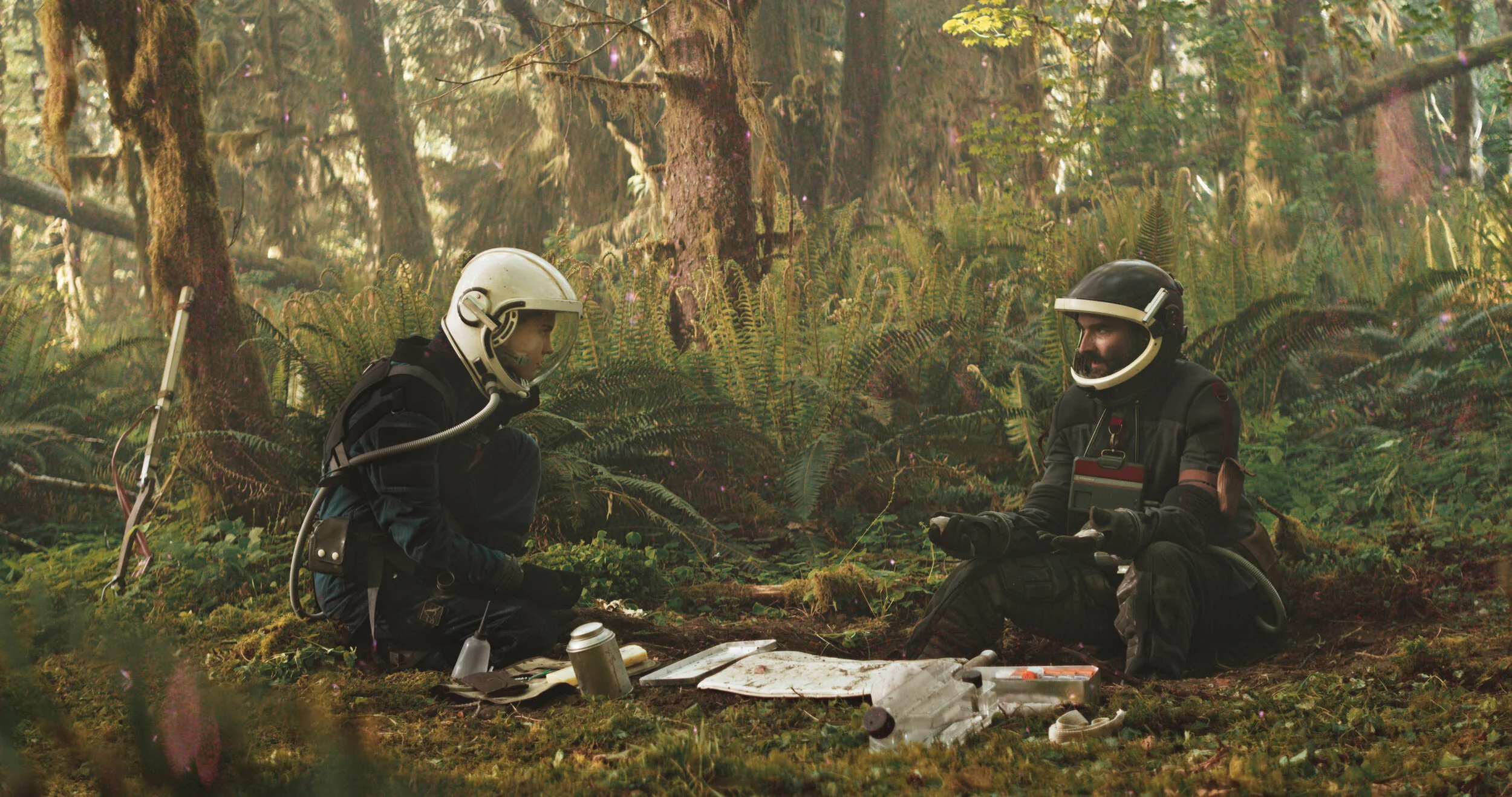
Prospect is a dystopian sci-fi film about a teenage girl and her father travelling to a remote alien moon, aiming to strike it rich. But there are others roving the wilderness, and the job quickly devolves into a desperate fight to survive.

The film keeps its perspective observational. There is very little exposition, so the audience learns where they are almost entirely from what they see on screen. That puts an unusual weight on the design of the world itself.

Graphics for film

Graphics for film

Not the posters or the credits. The fine print that immerses you in the world.

In film, "graphic designer" is a broad title. It can mean the title sequence and motion graphics, the marketing and key art, or post-production work. Mine was none of those. I designed graphics for props, set decoration, and costumes: the warning labels, instruction manuals, packaging, logos, advertisements, signage, and patches that fill the edges of a frame and dress the characters in it. None of it is the thing the audience is looking at, and all of it is the thing that convinces them the place is real.

A print sheet of "dry rub" decals that we would apply everywhere a label or a logo might be: providing an interface for characters to interact with
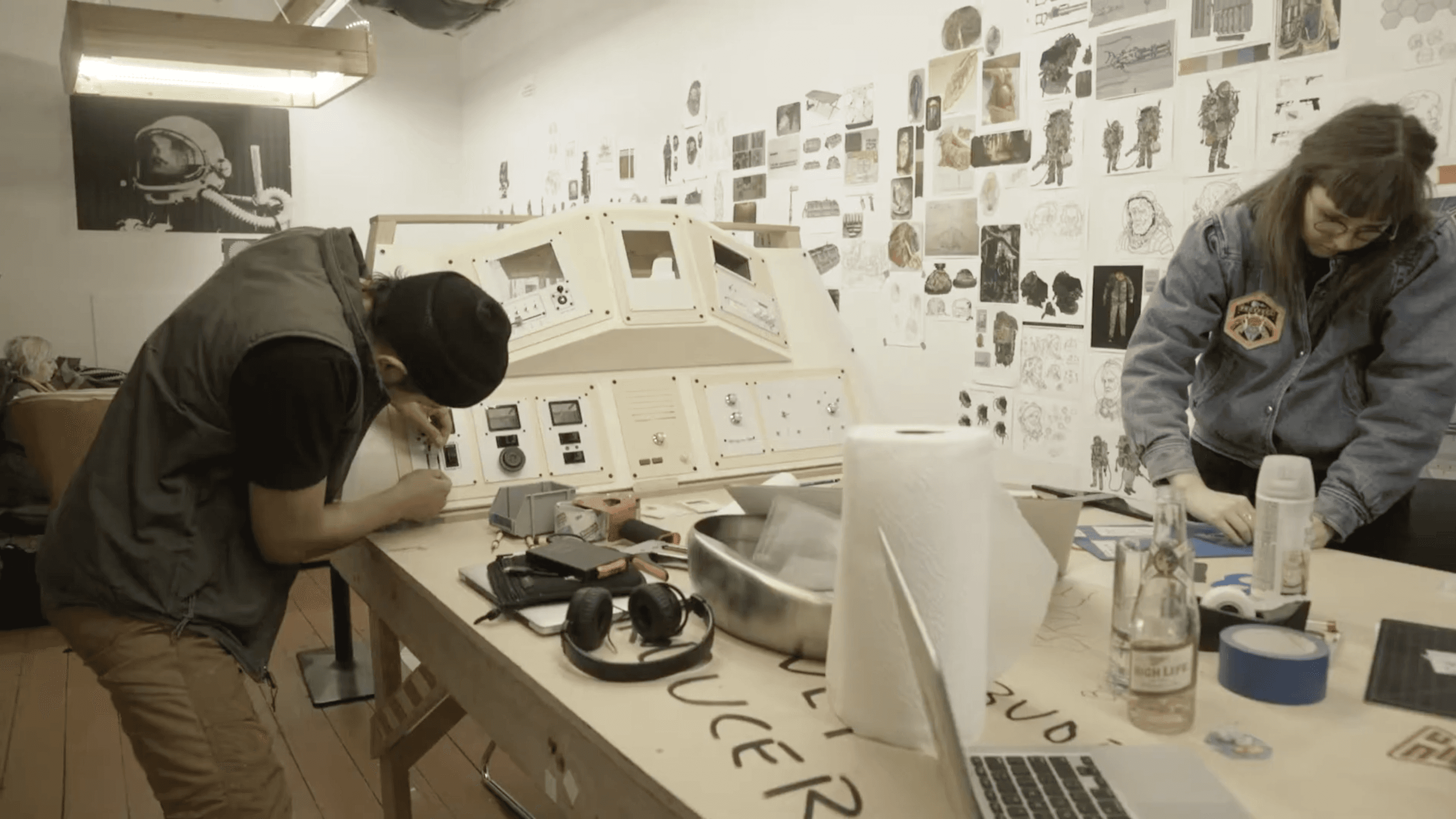
The meticulous application of the dry rubs by myself (right) and graphic design lead, Alex Park (Left)

The challenge

The challenge

The audience had two hours to load a new construct of reality in a universe they'd never seen.

The User: the viewer

The user here was the viewer: someone with no manual, no exposition, and about two hours to absorb a whole civilisation and believe it. Every object I designed was a bet on what that viewer would understand, trust, and feel in the half-second it was on screen.

The challenge: Immersion

The challenge was immersion. The audience needed to feel dropped into a completely new alien universe, and with only a couple of hours to do it, the world had to carry the rest of the story. Utility, cost, weight, and the implications of life on an alien frontier all had to be considered for every object that appeared.

The directors wanted the world to feel expansive and alive but to sit behind a small, intimate story. It had to feel incidental, like it extended well beyond the edges of the film, rather than built to order for it.
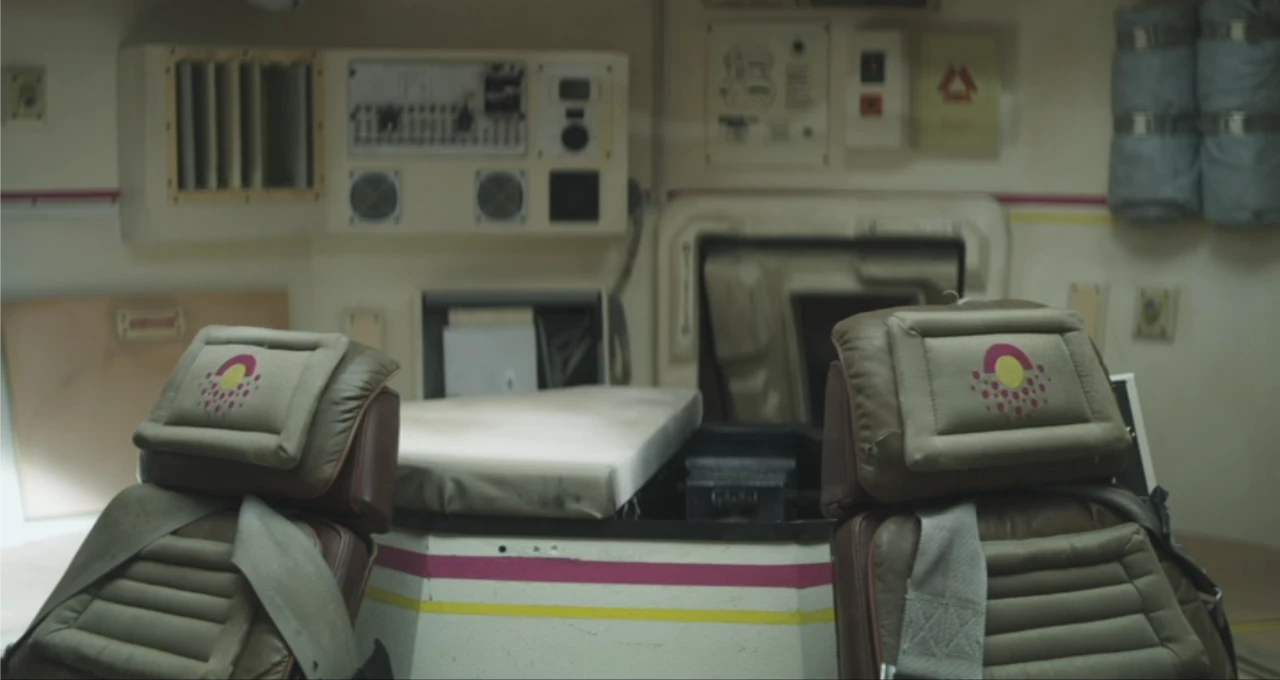
The interior of the drop pod that the characters live and conduct their work out of. Reminiscent of a 1970s u-haul or winnebago in space filled with branding, safety and instruction information, and signs of life, like the stickers of a teenage girl navigating a harsh universe.

Discovery

Discovery

We built their world out of ours.

Research

Though Prospect takes place on the uncivilised frontier of the galaxy, the directors still wanted evidence of civilisation buried in the corners. Pop culture, religion, politics, and consumer goods were all facets of humanity they wanted the audience to encounter. This universe was not our own, but we drew reference from many corners of the one that is.

The aesthetic was nicknamed "painted rust," a reference to the industrial output generated at breakneck speed by the USSR, built quickly and cheaply by an industrial power, then left out to weather. Everything in the film had to ride that line, expressing the progressive spirit of space travel but grounded by utilitarian and economic realities. Building the world also meant blending times and cultures, layering eras and influences until the place felt like it had a history of its own. We drew reference from the famously unmade Jodorowsky's Dune, whose maximal, invented world-building inspired the breadth and depth we wanted for the Prospect universe.

Right: A glimpse of the trove of reference images that informed the film, spanning decades and cultures
Left: The beginning workings of brands, labels, and alien cartoon characters that would go on to form the world

PRINCIPLES AND PROCESS

PRINCIPLES AND PROCESS

On a frontier with no exposition, what the audience felt came down to what we left in the corners of the frame.

Jodorowsky believed a symbolic, physical act could produce a real psychological effect. He called it Psychomagic. A warning label worn just enough works the same way: a symbolic object producing a real feeling of place.

That idea, more than any style reference, is what the four principles below were chasing.


1) A familiar symbol tells the audience they are still on Earth.


  • So we cut the shortcuts we take for granted, no red cross, no arrow, and designed only what would survive cycles of dark age and renaissance, keeping the world genuinely elsewhere.


2) Audiences trust wear, not polish.


  • A pristine object reads as a prop and a weathered one reads as a life, so every graphic rode the line between futuristic and worn.


3) A single glimpsed object can imply an entire world.


  • Nothing was decoration; each piece carried a history in its design, letting the audience feel the universe extend well beyond the frame.


4) Belief is built below conscious attention.

  • No one pauses to read the fine print, but they feel it when it is missing, so density and consistency did the quiet work.

These principles were not abstract rules. They were the filter every idea had to pass through. Each object followed the same path, from story to sketch to design to ageing, developed until it held the grounded but alien aesthetic, whether it was a space U-Haul or a wall of shipping containers. If an idea could not survive the dark age and renaissance test or the painted-rust look, it went back to the page. Development was where the thinking became something an audience could believe.

On a frontier with no exposition, what the audience felt came down to what we left in the corners of the frame.

Jodorowsky believed a symbolic, physical act could produce a real psychological effect. He called it Psychomagic. A warning label worn just enough works the same way: a symbolic object producing a real feeling of place.

That idea, more than any style reference, is what the four principles below were chasing.

  • A familiar symbol tells the audience they are still on Earth. So we cut the shortcuts we take for granted, no red cross, no arrow, and designed only what would survive cycles of dark age and renaissance, keeping the world genuinely elsewhere.

  • Audiences trust wear, not polish. A pristine object reads as a prop and a weathered one reads as a life, so every graphic rode the line between futuristic and worn.

  • A single glimpsed object can imply an entire world. Nothing was decoration; each piece carried a history in its design, letting the audience feel the universe extend well beyond the frame.

  • Belief is built below conscious attention. No one pauses to read the fine print, but they feel it when it is missing, so density and consistency did the quiet work.

These principles were not abstract rules. They were the filter every idea had to pass through. Each object followed the same path, from story to sketch to design to ageing, developed until it held the grounded but alien aesthetic, whether it was a space U-Haul or a wall of shipping containers. If an idea could not survive the dark age and renaissance test or the painted-rust look, it went back to the page. Development was where the thinking became something an audience could believe.

On a frontier with no exposition, what the audience felt came down to what we left in the corners of the frame.

Jodorowsky believed a symbolic, physical act could produce a real psychological effect. He called it Psychomagic. A warning label worn just enough works the same way: a symbolic object producing a real feeling of place.

That idea, more than any style reference, is what the four principles below were chasing.

  • A familiar symbol tells the audience they are still on Earth. So we cut the shortcuts we take for granted, no red cross, no arrow, and designed only what would survive cycles of dark age and renaissance, keeping the world genuinely elsewhere.

  • Audiences trust wear, not polish. A pristine object reads as a prop and a weathered one reads as a life, so every graphic rode the line between futuristic and worn.

  • A single glimpsed object can imply an entire world. Nothing was decoration; each piece carried a history in its design, letting the audience feel the universe extend well beyond the frame.

  • Belief is built below conscious attention. No one pauses to read the fine print, but they feel it when it is missing, so density and consistency did the quiet work.

These principles were not abstract rules. They were the filter every idea had to pass through. Each object followed the same path, from story to sketch to design to ageing, developed until it held the grounded but alien aesthetic, whether it was a space U-Haul or a wall of shipping containers. If an idea could not survive the dark age and renaissance test or the painted-rust look, it went back to the page. Development was where the thinking became something an audience could believe.

On a frontier with no exposition, what the audience felt came down to what we left in the corners of the frame.

Jodorowsky believed a symbolic, physical act could produce a real psychological effect. He called it Psychomagic. A warning label worn just enough works the same way: a symbolic object producing a real feeling of place.

That idea, more than any style reference, is what the four principles below were chasing.

  • A familiar symbol tells the audience they are still on Earth. So we cut the shortcuts we take for granted, no red cross, no arrow, and designed only what would survive cycles of dark age and renaissance, keeping the world genuinely elsewhere.

  • Audiences trust wear, not polish. A pristine object reads as a prop and a weathered one reads as a life, so every graphic rode the line between futuristic and worn.

  • A single glimpsed object can imply an entire world. Nothing was decoration; each piece carried a history in its design, letting the audience feel the universe extend well beyond the frame.

  • Belief is built below conscious attention. No one pauses to read the fine print, but they feel it when it is missing, so density and consistency did the quiet work.

These principles were not abstract rules. They were the filter every idea had to pass through. Each object followed the same path, from story to sketch to design to ageing, developed until it held the grounded but alien aesthetic, whether it was a space U-Haul or a wall of shipping containers. If an idea could not survive the dark age and renaissance test or the painted-rust look, it went back to the page. Development was where the thinking became something an audience could believe.

The control panel of the pod with functioning screens, a handwritten instruction note providing reminders to a complicated instrument and the branding of the control panel company

Signs of life within a space caravan, like the stickers of a teenage girl navigating a harsh universe featuring her favourite cartoon characters and brands
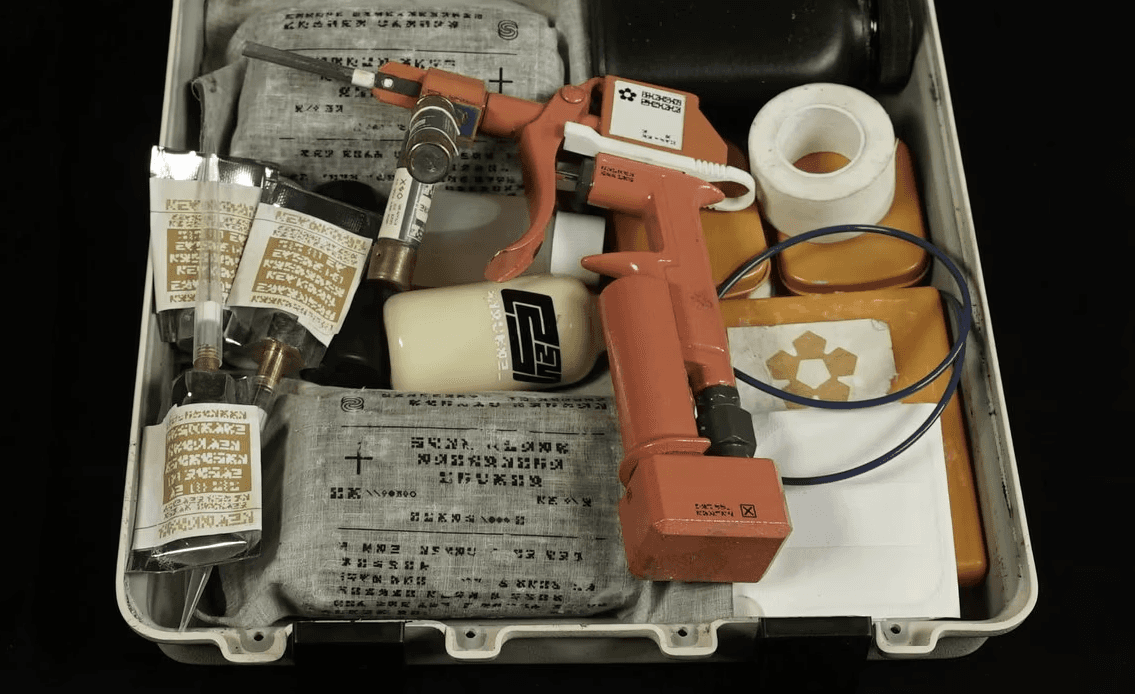
The med kit used in a pivotal scene featuring the Prospect universe orange flower in the stead of a green cross and convoluted packaging based on soviet medical packaging

Designing the world

Designing the world

From an alphabet no one had ever written to a brand on a passing container, the world was built one object at a time.

The Language

A world feels truly alien the moment the audience cannot read a word of it. Nothing in this universe could be written in any language that exists on Earth: the solution was to give the world its own language from the ground up. The written alphabet was developed by our concept artist, Laurie Greasley, with calligraphic, machine, and handwriting systems. Reporting to graphics lead Alex Park, I digitised the machine glyph system from her hand-drawn source; Luke Dietz then built it out into a working OTF font, so every label, manual, and logo would read as real text without being text a viewer could recognise. It worked almost too well. Years later, fans have decoded the glyphs frame by frame and reconstructed the alphabet themselves.

The Objects

From there the world filled in piece by piece, each object carrying a small story. The drop pod the characters live in was written as a rental, the space equivalent of a U-Haul, so its branding had to feel rented rather than owned. Down to the slurry packs they ate from and the brands on passing shipping containers, every piece added up to a world that felt interconnected and a little messy, the way real commerce is.

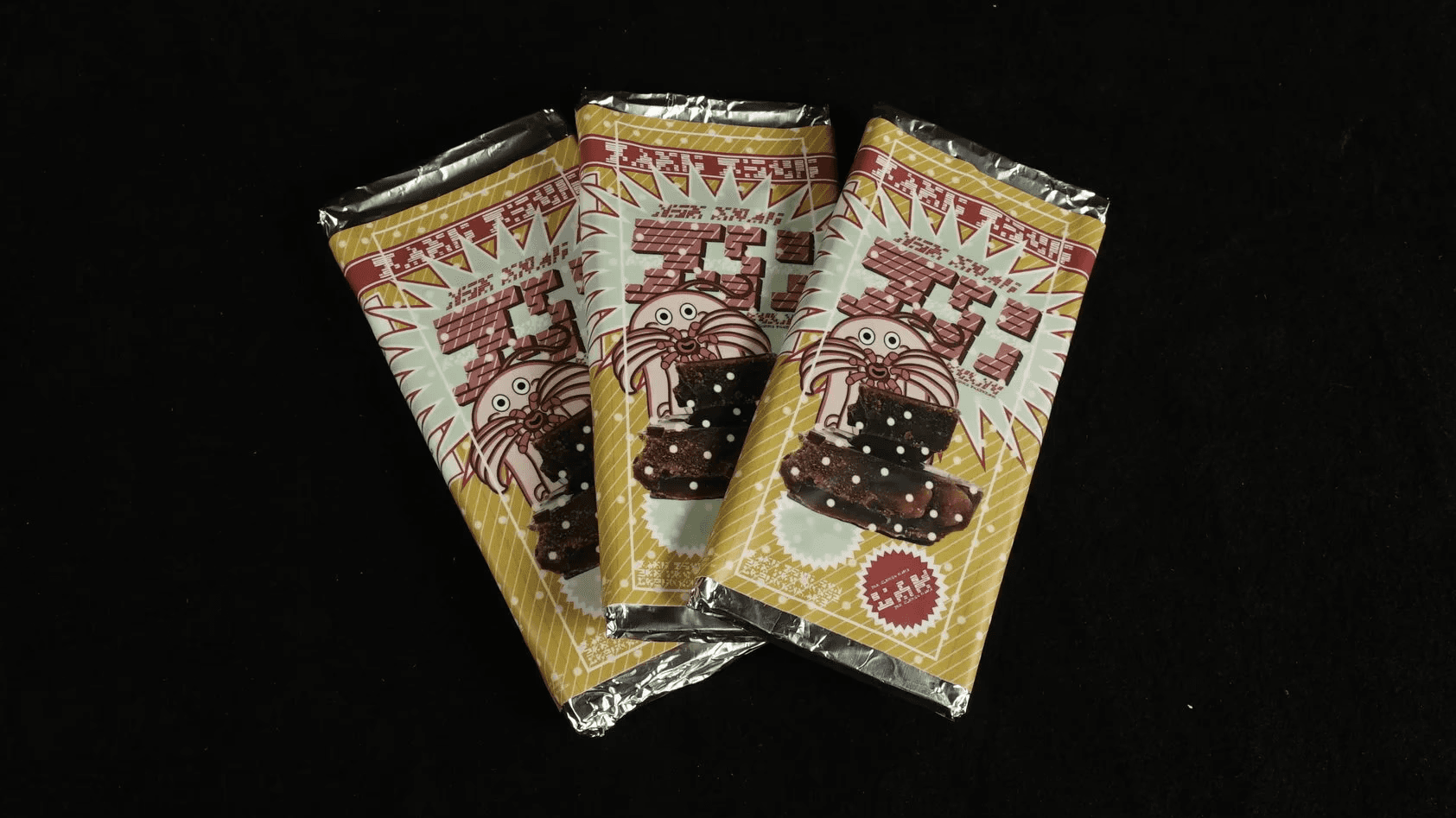
The packaging for the "bits bars" featuring Kyoku a cartoon character well-known in the universe

The packaging for the "slurry packs", nutritional slop that the characters depend on with fruits alien and earth-adjacent, well-worn from their travels

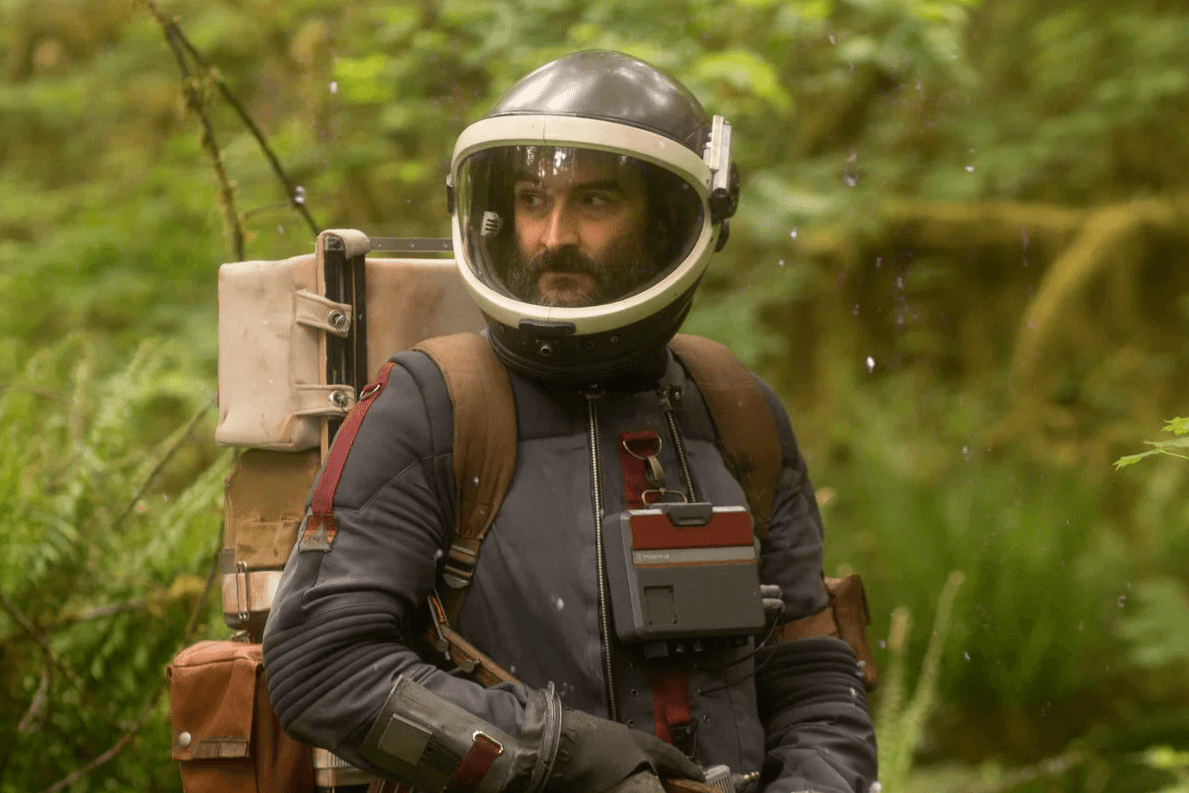
The brand patch on a main character's suit reminiscent of 70s Patagonia. Outdoor wear for space.

Stage 1

Awareness

Objective: Would users find proof of expertise on their own?

Result: Users didn't navigate the way I'd designed for: one skipped the homepage for the Studio page, and the word "experience" read as "the whole site" for others. Underneath, greyed-out wireframes made work hard to judge without images, and people reached for different proof, testimonials, named clients, scale, not just case studies.

People don't evaluate credibility the same way, and a homepage can't assume the scroll.

From sketch to screen

From sketch to screen

Following one prop from a blank page to something worn, used, and full of history.

The map the main character navigates by shows the full path every object travelled.

The map the main character navigates by shows the full path every object travelled.

The map the main character navigates by shows the full path every object travelled.

Story
Story
Story

It had to *work*, not just look right. She actually finds her way with it in a lethal environment, so it had to function as a real map.

It had to *work*, not just look right. She actually finds her way with it in a lethal environment, so it had to function as a real map.

It had to *work*, not just look right. She actually finds her way with it in a lethal environment, so it had to function as a real map.

Sketching, Tracing, and Alienation (Illustrator)

I hand-traced the real topography of the shooting location in illustrator, grounding the alien in something true. I then laid radiation lines over the terrain, markings that would never appear on an ordinary map, fusing our world with theirs on one sheet.

I hand-traced the real topography of the shooting location in illustrator, grounding the alien in something true. I then laid radiation lines over the terrain, markings that would never appear on an ordinary map, fusing our world with theirs on one sheet.

I hand-traced the real topography of the shooting location in illustrator, grounding the alien in something true. I then laid radiation lines over the terrain, markings that would never appear on an ordinary map, fusing our world with theirs on one sheet.

Made Real
Made Real
Made Real

Printed on waterproof banner material, chosen for how the prop would actually be used.

Printed on waterproof banner material, chosen for how the prop would actually be used.

Printed on waterproof banner material, chosen for how the prop would actually be used.

Aged and weathered
Aged and weathered
Aged and weathered

Annotated by an illustrator in the film's invented language, then dragged through dirt until it read as well-worn.

Annotated by an illustrator in the film's invented language, then dragged through dirt until it read as well-worn.

Annotated by an illustrator in the film's invented language, then dragged through dirt until it read as well-worn.

On screen

On screen

Prospect was designed so no one would stop to read a slurry pack. Its fans now pause to read them anyway.

The digital files were printed across various mediums, applied to props, costumes, and sets, and then treated to bring them to life. That final ageing layer was what integrated each piece into the world rather than leaving it looking freshly produced for a film. On screen, the result is a universe dense enough to feel like it extends past the frame, where warning labels, brands, manuals, and signage quietly do the work of making an invented place feel real. The world was built to go unnoticed, but the depth of it has since earned the film a cult following that pores over exactly those details, frame by frame.

High impact, lower effort:

  • Case studies: the proof people trust before anything else

  • About / Who We Are: the cultural fit they want to feel before committing

  • Services: clarity on the 360° offer, so no one has to decode it

  • Calendly integration: the fastest route to a real conversation

  • Contact form: visible and prominent, so reaching out never feels like work

High impact, higher effort:

  • Insights / blog: demonstrates thought leadership and keeps the site active

  • Individual team member pages: the human layer

Future iteration:

  • Events / recent activity: amplifies the human layer

High impact, lower effort:

  • Case studies: the proof people trust before anything else

  • About / Who We Are: the cultural fit they want to feel before committing

  • Services: clarity on the 360° offer, so no one has to decode it

  • Calendly integration: the fastest route to a real conversation

  • Contact form: visible and prominent, so reaching out never feels like work

High impact, higher effort:

  • Insights / blog: demonstrates thought leadership and keeps the site active

  • Individual team member pages: the human layer

Future iteration:

  • Events / recent activity: amplifies the human layer

High impact, lower effort:

  • Case studies: the proof people trust before anything else

  • About / Who We Are: the cultural fit they want to feel before committing

  • Services: clarity on the 360° offer, so no one has to decode it

  • Calendly integration: the fastest route to a real conversation

  • Contact form: visible and prominent, so reaching out never feels like work

High impact, higher effort:

  • Insights / blog: demonstrates thought leadership and keeps the site active

  • Individual team member pages: the human layer

Future iteration:

  • Events / recent activity: amplifies the human layer

The retrospective ux lens

The retrospective ux lens

On an alien moon that never existed, I learned to design for what a person walks away believing, not just what sits in front of them.

Prospect was film graphics, not UX, but the thinking maps closely. The audience was the user: a slurry pack had to read as a product at a glance, the map had to work as something you could navigate by, the drop pod had to feel rented. Each was a bet on what the audience would understand and trust. Some of it was interface design in all but name, like the pod's control-panel screens (my part was the labels), all of it built to act on how people felt, not just what they read.

Film curates one linear journey, not a website to wander, so every frame has to carry the story. But the gamble at its centre, that what you intend is what people perceive, is the exact gap user research exists to close. Film accepts that risk as its magic; UX gives you a way to test it. I was designing for emotion, perception, and belief long before I had the language for it, and what I would bring now is the means to check that the experience I imagined is the one people actually have.

Prospect was film graphics, not UX, but the thinking maps closely. The audience was the user: a slurry pack had to read as a product at a glance, the map had to work as something you could navigate by, the drop pod had to feel rented. Each was a bet on what the audience would understand and trust. Some of it was interface design in all but name, like the pod's control-panel screens (my part was the labels), all of it built to act on how people felt, not just what they read.

Film curates one linear journey, not a website to wander, so every frame has to carry the story. But the gamble at its centre, that what you intend is what people perceive, is the exact gap user research exists to close. Film accepts that risk as its magic; UX gives you a way to test it. I was designing for emotion, perception, and belief long before I had the language for it, and what I would bring now is the means to check that the experience I imagined is the one people actually have.

Prospect was film graphics, not UX, but the thinking maps closely. The audience was the user: a slurry pack had to read as a product at a glance, the map had to work as something you could navigate by, the drop pod had to feel rented. Each was a bet on what the audience would understand and trust. Some of it was interface design in all but name, like the pod's control-panel screens (my part was the labels), all of it built to act on how people felt, not just what they read.

Film curates one linear journey, not a website to wander, so every frame has to carry the story. But the gamble at its centre, that what you intend is what people perceive, is the exact gap user research exists to close. Film accepts that risk as its magic; UX gives you a way to test it. I was designing for emotion, perception, and belief long before I had the language for it, and what I would bring now is the means to check that the experience I imagined is the one people actually have.

Prospect Official Trailer